Spray cork render is a flexible, sprayed coating made from granulated cork blended with resins and pigments. It's crack-bridging, water-repellent, breathable and lightly insulating, and can be sprayed over many surfaces including existing render, brick and pebbledash. Expect to pay around £40–£70 per m² in the UK. It's a newer, eco-flavoured alternative in the rendering market, often marketed for crack-prone and damp-prone walls.
It's not a traditional render at all but a thick, elastic sprayed coating — think of it as a high-performance flexible skin rather than a cement finish.
- A sprayed coating of granulated cork, resin and pigment — flexible and elastic, not a cement render.
- Crack-bridging and water-repellent while staying breathable, with modest thermal and anti-condensation benefits.
- Can be applied over render, brick, pebbledash and more, often with minimal removal.
- Self-coloured and lightweight; typical UK cost £40–£70/m².
- Marketed heavily for crack and damp issues — useful, but not a structural or full-insulation fix.
What is spray cork render?
Spray cork render is one of the newer arrivals in the UK market, and strictly speaking it isn't a render at all — it's a flexible sprayed coating. It's made from finely granulated natural cork blended with water-based resins and pigments, then sprayed onto the wall to build up a thick, elastic, textured skin.
That elasticity is the headline feature. Because the coating flexes, it bridges hairline cracks and moves with the building rather than cracking like rigid cement render. It's also water-repellent yet breathable, lightweight, and self-coloured so it needs no painting. Manufacturers market additional benefits too — modest thermal insulation, reduced surface condensation, and sound damping — thanks to cork's natural properties.
A practical advantage is versatility: spray cork can be applied over a wide range of substrates — existing sound render, brick, pebbledash, timber, even uPVC and concrete — often with less removal and preparation than a traditional re-render. That makes it attractive for refreshing tired or crack-prone walls without a full strip-back. It's positioned as a premium, eco-flavoured, problem-solving coating, though it's wise to keep its claims in perspective: it's a coating, not a structural repair or a substitute for proper insulation.
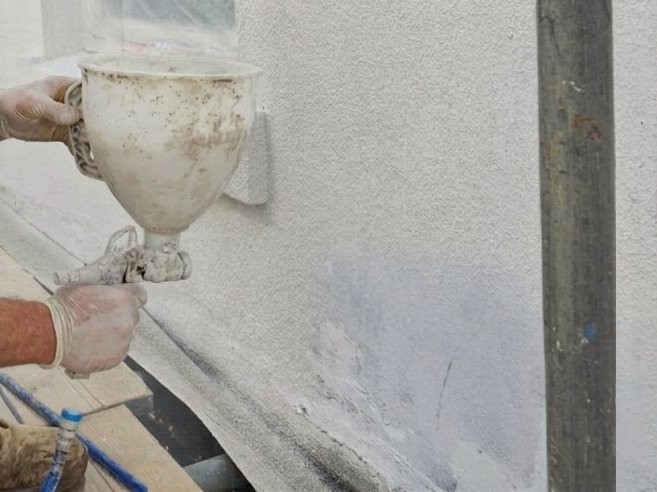
How spray cork render works
- Preparation — the surface is cleaned and made sound; loose material is removed and a primer is applied for adhesion.
- Spray application — the cork coating is spray-applied with a hopper gun, usually in two or more passes to build the required thickness and even texture.
- Curing — the water-based coating cures to a flexible, durable, self-coloured skin.
The cork granules give the coating its flexibility and light insulating quality, while the resin binds it and makes it water-repellent. Because the film flexes, it accommodates the small movements that crack rigid renders, and because it's vapour-permeable, the wall can still breathe. The result is a tough, elastic, low-maintenance surface that resists cracking — its main selling point over cement-based finishes.
How is spray cork applied?
- Access and prep — scaffolding, cleaning, repairs to anything unsound, and priming.
- Masking — windows, doors and surfaces are masked, as spraying is less contained than trowelling.
- Spraying in passes — the coating is applied in multiple passes for even coverage and texture.
- Curing — left to cure to its final flexible finish.
Spray application is faster than building up a traditional render system and the lighter weight means it's less demanding on the substrate. As with all coatings it shouldn't be applied in frost or heavy rain. Thorough masking and a steady spraying technique are essential for a clean, even result.
Benefits of spray cork render
- Crack-bridging — its elasticity covers and resists hairline cracks that defeat rigid renders.
- Flexible and durable — moves with the building instead of cracking.
- Water-repellent yet breathable — sheds rain while letting the wall dry.
- Applies over many substrates — render, brick, pebbledash, concrete, timber, uPVC and more, often with less removal.
- Lightweight — adds little load and suits weaker substrates.
- Self-coloured — no painting, available in a range of colours.
- Modest thermal and anti-condensation benefit — cork's natural properties reduce surface cold-spots and condensation.
- Eco-flavoured — uses a natural, renewable material.
Got crack-prone or tired walls? Get a free, no-obligation quote from one vetted spray cork specialist.
Get a free quote →Drawbacks and things to consider
- Not a structural or damp cure — it bridges hairline cracks and sheds rain, but won't fix structural movement, serious cracks or underlying damp.
- Modest insulation only — the thermal benefit is real but small; it's not a substitute for proper external wall insulation.
- Marketing vs reality — claims can be oversold, so judge it as a quality flexible coating, not a miracle product.
- Fewer experienced installers — a newer product, so genuine experience varies; the installer matters.
- Premium price for a coating — costs sit alongside silicone render despite being a different kind of product.
- Texture and finish — the sprayed texture differs from a trowelled render; some prefer the look of a scraped or smooth finish.
How much does spray cork render cost in the UK?
Spray cork typically costs £40–£70 per square metre applied, broadly in line with silicone render. Whole-property guides:
| Property | Typical cost |
|---|---|
| Per m² | £40–£70 |
| Mid-terrace house | £3,800–£6,500 |
| 3-bed semi-detached | £4,500–£9,000 |
| Detached house | £8,500–£14,000+ |
Budget figures only. Spray cork can be cheaper to apply where it goes over a sound existing surface with minimal removal. A survey gives the accurate number.
What affects the price?
- Substrate condition — applying over a sound surface is cheaper than extensive repair or removal.
- Number of coats/thickness — more passes for a thicker, more textured finish.
- Access and scaffolding — height and elevations.
- Masking and protection — spraying needs careful masking, which adds labour.
- Colour and product brand — premium systems cost more.
- Region — labour rates vary nationally.
Spray cork vs other finishes
| Spray Cork | Silicone | Acrylic | EWI | |
|---|---|---|---|---|
| Type | Flexible coating | Thin-coat render | Thin-coat render | Insulation + render |
| Crack-bridging | High | Medium | Medium | Medium |
| Breathable | Medium-high | High | Low | Varies |
| Insulation | Modest | None | None | High |
| Applies over old surfaces | Very well | If sound | If sound | Yes |
| Relative cost | £££ | £££ | ££ | ££££ |
Against silicone render, spray cork's edge is crack-bridging flexibility and the ability to go over awkward substrates with less removal; silicone breathes a little better and has a longer track record. If your real goal is warmth and energy saving, external wall insulation delivers far more than cork's modest thermal benefit. Compared with acrylic, cork is more flexible and breathable. It's best seen as a specialist flexible coating for crack-prone or hard-to-render walls.
Is spray cork render right for your home?
- Crack-prone walls — where rigid render keeps cracking, cork's flexibility helps.
- Tired surfaces you'd rather coat than strip — render, pebbledash or brick that's sound but dated.
- Mixed or awkward substrates — where a single coating over varied surfaces is convenient.
- Owners wanting a natural-material, low-maintenance finish — with a modest thermal bonus.
It's not the right answer if you need real insulation (choose EWI), a structural repair (fix the cause first), or a traditional breathable finish for a listed building (use lime). A good installer will be honest about what cork can and can't do for your specific walls.
Maintenance, cleaning and lifespan
Spray cork is low-maintenance and self-coloured, with manufacturers typically quoting lifespans of 15–25 years or more depending on the product and exposure. The flexible surface resists cracking and sheds rain; it can be cleaned gently with a soft brush and mild wash. As with any coating, keeping gutters and detailing sound so water isn't constantly running over the surface helps it last.
Common problems (and how to avoid them)
- Expecting it to fix damp or structural cracks — it won't; the underlying cause must be addressed first.
- Poor adhesion — from skipping priming or applying over an unsound surface; proper prep prevents it.
- Overspray and uneven texture — from rushed spraying or poor masking; an experienced applicator avoids it.
- Disappointment from oversold claims — set realistic expectations: it's a quality flexible coating, not a cure-all.
Spray cork colours and finishes
Spray cork is self-coloured and comes in a range of shades, typically the soft whites, creams, greys and earthy tones that suit UK homes, with the natural cork content giving the surface a subtly warmer, more textured character than a flat painted wall. Because the colour is integral to the coating there's no painting to maintain. The finish itself is a fine, slightly granular texture from the spray application — different in feel from a trowelled or scraped render, which some homeowners love for its softer look and others find takes getting used to. As with any self-coloured finish, it's worth seeing a sample panel on your own wall, in daylight, before committing, since the texture and colour read differently at scale than on a small swatch.
How to choose the right spray cork installer
Because spray cork is newer and heavily marketed, genuine installer experience varies a lot — and so does honesty about what it can achieve. Look for an applicator who has done multiple local cork jobs, primes and prepares properly, and gives you a straight assessment of whether cork (versus silicone or EWI) is right for your walls. RenderSmart's SmartMatch™ weighs experience, verified reviews and reputation to pair you with the one best-fit local specialist, so you get realistic advice rather than a sales pitch.
Frequently asked questions
What is spray cork render?
Does spray cork render stop cracks?
Is spray cork render any good?
How much does spray cork render cost?
Can spray cork be applied over pebbledash or render?
Does spray cork render insulate?
Is spray cork render breathable?
How long does spray cork render last?
Does spray cork render need painting?
Can spray cork render fix damp?
Is spray cork render eco-friendly?
Spray cork vs silicone render — which is better?
Is spray cork render waterproof?
Why are there mixed reviews of spray cork?
Do I need planning permission to render my house?
Does rendering need building regulations approval?
Get a free spray cork quote
Tell us about your property and SmartMatch™ pairs you with one vetted local spray cork specialist — for a free, no-obligation quote and survey.
Get a free quote →